
| TL;DR Score every candidate as relevance × intent × profitability, each out of 5. The working floor is 100 points.Break-even ACoS equals your margin. At a 30% margin, 30% ACoS is the line where you stop making money.A term with 10 to 15 clicks and zero sales is a negative-targeting candidate, not a patience problem.Raise bids on the top 10% of keywords that deliver 80% of sales. Leave the rest alone. Short version: most PPC keyword research is a list-building exercise. The useful version is a scoring exercise, and the score has a floor you can state before you spend anything. |
Three numbers decide whether an Amazon campaign works: click-through rate, conversion rate, and advertising cost of sale. Everything else is a means of moving one of them.
That sounds obvious and it is routinely ignored, because keyword tools optimize for a fourth number that appears on none of those lines. Search volume tells you how many people could see an ad. It says nothing about whether any of them would click it, buy from it, or leave you with money afterwards.
Start With the Number That Ends the Argument
Break-even ACoS is your margin. If your product carries a 30% margin, a 30% ACoS means you are running the campaign for free. Above that you are paying for the privilege.
This single figure resolves most bidding disputes before they start, and it is worth calculating first because it turns every subsequent decision into arithmetic. A $20 product where the generic term costs $5 a click needs a conversion rate most listings do not have. You can know that before running the campaign rather than after.
The full workflow for keyword research for Amazon PPC runs this as seven steps, from mining auto campaigns through match-type architecture to weekly hygiene, and it puts the qualification step before the expansion step deliberately.
Score on Three Axes
Two-axis scoring is common. Three is better, because the axis usually missing is the one that determines whether a sale is worth making.
Relevance, out of five: does the term describe what you actually sell. Intent, out of five: is the person typing it buying or researching. Profitability, out of five: given the likely cost per click and your margin, does a conversion leave anything behind.
Multiply, do not add. The working floor is 100 points out of a possible 125, which sounds severe until you notice what it excludes. A term scoring 5 and 5 on relevance and intent but 3 on profitability lands at 75 and does not clear. That is correct. It is a term that will convert and lose money, which is worse than a term that does not convert, because it scales.
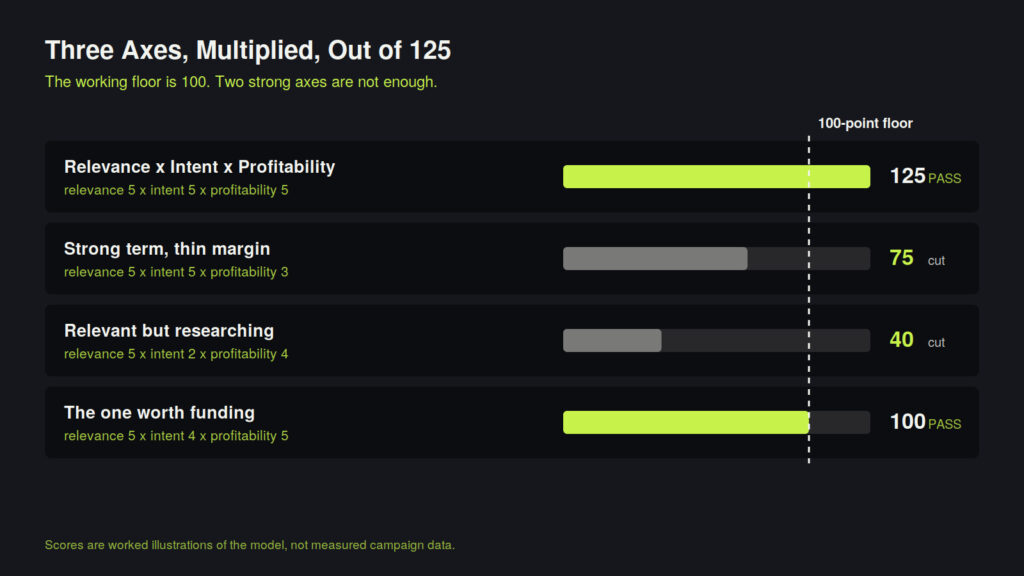
Multiplying is what makes the floor bite. One weak axis pulls the whole score under it.
The Modifier Families Do the Generating
Long-tail terms are produced, not discovered. Six modifier families cover most of it: size, material, pack quantity, feature, audience and compatibility. Run a product through all six and you get phrases like “set of 3” attached to things nobody would have thought to search for by staring at an export.
This is also where competitor data earns its place. A reverse ASIN lookup on your top three competitors returns the vocabulary the category actually uses. Not the vocabulary you would use, which is a different and consistently worse list, because you know what your product is called and your buyers do not.
That distinction is the same one the Small Business Administration makes in its guidance on market research and competitive analysis, which frames the job as blending consumer behavior with economic trends to confirm an idea rather than to justify it. The confirm-or-kill framing matters. Keyword research done to validate a decision already made produces a list that agrees with you.
Read the Search Term Report Like a Clock
For the first 14 days of a campaign, check the search term report twice a week. After that, weekly.
Twice-weekly sounds excessive and is not, because the first fortnight is when the auto campaign is spending money to produce information and the information decays. A term that burned budget on day three is cheaper to negate on day four than on day thirty.
Two thresholds govern what you do with what you find.
Promote a term that has produced 2 or more orders with an ACoS below target over a 30-day period. It has earned a manual campaign and a deliberate bid.
Negate a term with 10 to 15 clicks and zero sales. This is the harder call, because ten clicks feels like a small sample. It is a small sample, and it is also fifty dollars at a five-dollar cost per click. The question is not whether ten clicks proves the term cannot convert. It is whether you want to buy another ten to find out.
The Three-Bucket Cleanup
Weekly hygiene works best as a sort rather than a review. Every term in the report goes into one of three buckets: promote, negate, or leave alone.
The third bucket is the one people struggle with. A term with four clicks and no sales is not yet evidence of anything, and touching it is a decision made on noise. Leave it. The discipline of doing nothing to the middle bucket is what keeps the top and bottom buckets meaningful.
Scaling follows the same restraint. Raise bids on the top 10% of keywords that deliver roughly 80% of sales, and resist spreading budget across the tail to see what happens. You already know what happens.
Where Advertising Rules Bite
One thing worth flagging because it sits adjacent to campaign work and is easy to get wrong.
Amazon advertising is advertising, and the claims inside it are regulated. The Federal Trade Commission’s endorsement guides are explicit that endorsements must be honest, that material connections between a marketer and an endorser must be disclosed, and that advertisers are responsible for reasonably training and monitoring the networks acting on their behalf.
For a seller running PPC that translates into two practical constraints. Comparative claims in ad copy need substantiation you could actually produce. And if an agency or freelancer manages your campaigns, their compliance is your exposure, not theirs.
The Star-Rating Asymmetry
A last input that changes bidding and is rarely modeled.
If your product carries 4.5 stars and the competitor holding a term carries 3.8, you can afford a higher bid on that term than they can, because your conversion rate on the same traffic will be higher. The reverse is also true and less comfortable. Bidding aggressively on a term where you are the lower-rated option means paying more per click for traffic that converts worse.
Rating is not a keyword metric and it belongs in the profitability axis of the score, because it changes what a click is worth. Two sellers can look at the same term, run the same arithmetic, and correctly reach opposite conclusions.
Run the Score Before the Campaign
Take the twenty terms you are currently bidding on and score each one on the three axes. Terms below 100 are either losing money now or will as soon as competition arrives.
Most sellers doing this the first time find two or three terms they have been funding on relevance alone. Those are the cheapest wins available, because stopping costs nothing.