

In the theater of decision-making, imagine a magician who cannot turn back time but can conjure an alternate version of history — one where a single decision never took place. This magician is the Synthetic Control Method (SCM), a powerful statistical illusion that allows researchers, analysts, and policymakers to estimate what might have happened if a policy, event, or intervention had never occurred.
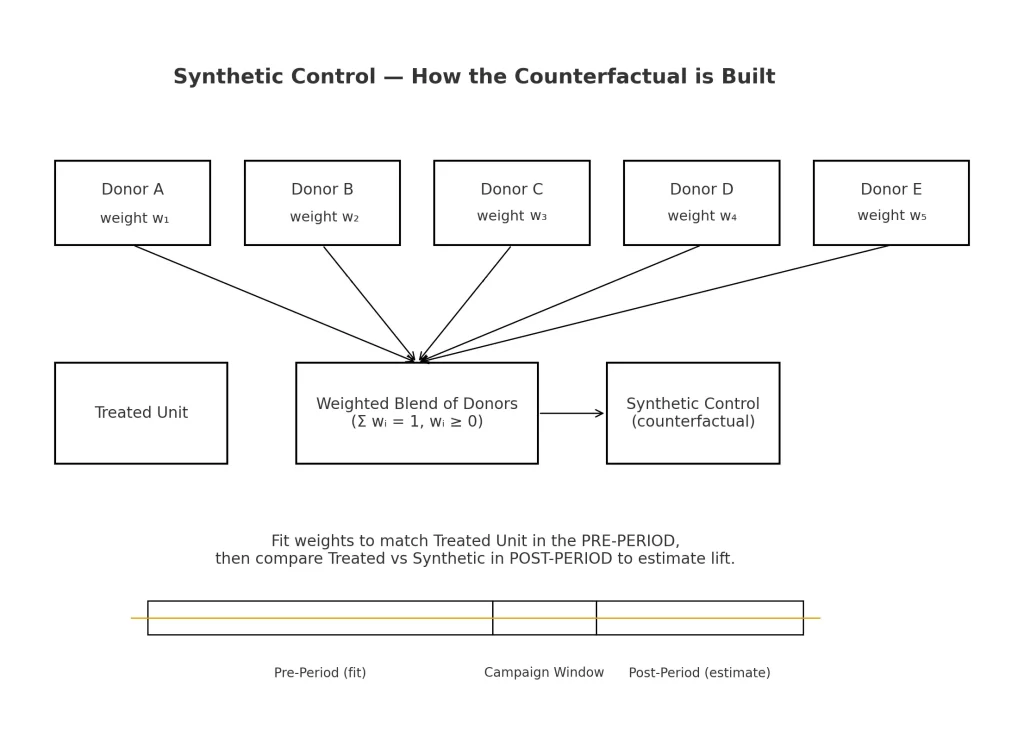
Rather than comparing one treated entity to a single control, SCM constructs an artificial twin — a weighted blend of other comparable entities that together mirror the behavior of the treated unit before the intervention. This “synthetic twin” becomes a believable counterfactual, revealing how reality could have unfolded differently.
For professionals exploring advanced analytics through a data scientist course, SCM offers a glimpse into how modern causal inference transcends simple comparisons — turning raw numbers into alternate histories.
1. The Art of Stitching Shadows: How SCM Creates Its Counterpart
Imagine standing before a painting that was once complete but now partially altered — perhaps a new color has been added or an entire figure has been erased. To understand how the painting once looked, you could piece together fragments from other works by the same artist. The Synthetic Control Method works in precisely this way.
It takes fragments — data points from several “non-treated” entities — and stitches them into a composite image that reflects the pre-intervention state of the treated unit. These fragments are assigned weights so that their combination closely resembles the original.
This process isn’t about prediction but recreation. It’s about constructing the past as faithfully as possible — a counterfactual built not from imagination, but from evidence. For learners advancing through a data scientist course, SCM illustrates the fusion of creativity and computation — where mathematics helps rebuild reality’s lost versions.
2. When History Meets Hypothesis: The Philosophy Behind SCM
Every policy, innovation, or disruption leaves behind a trail of “what ifs.” Economists wonder how a city would have grown without a new tax policy; environmentalists ask what would have happened without a regulation; marketers ponder the impact of a campaign that never aired.
Traditional comparisons — like before-and-after studies — often stumble because the world never stays still. External factors muddy the waters. SCM steps in as a philosopher-statistician, asking: If I can recreate the past using others’ trajectories, can I see how things would have evolved without intervention?
Through this lens, SCM becomes more than an analytical method — it’s a reflection on causality itself. It acknowledges that we can never truly isolate a single event in history, but with careful craftsmanship, we can approximate the unseen.
Students engaging in a data science course in Pune often find SCM a transformative concept — a bridge between numbers and narratives, between data and philosophy.
3. The Hidden Orchestra: Weighting Without Bias
Think of SCM as a conductor assembling an orchestra. Each “instrument” — representing a non-treated unit — has its distinct pitch and rhythm. Alone, none can replicate the symphony of the treated unit. But when weighted perfectly, their combined harmony mirrors the melody that once was.
These weights aren’t arbitrary. They’re tuned mathematically so that the synthetic version echoes the original’s pre-intervention performance. When an external policy or event occurs, analysts can observe the divergence between the real and synthetic lines — the measurable impact of change.
In a world where organizations crave precision, this balance between statistical rigor and interpretive clarity is invaluable. SCM doesn’t just analyze; it orchestrates meaning — a skill emphasized in any modern data scientist course that focuses on causal inference and model interpretation.
4. Beyond Numbers: SCM in the Age of Decisions
The modern enterprise operates on decisions that ripple through markets, societies, and ecosystems. Governments use SCM to measure the true effect of lockdowns or economic reforms. Corporates apply it to assess brand interventions or sustainability policies. NGOs leverage it to evaluate the outcomes of community programs.
In each case, SCM transforms speculation into structured evidence. It provides a quantitative backbone to narratives that might otherwise remain anecdotal. By constructing a synthetic version of reality, decision-makers can see — with mathematical precision — what their world might have looked like if they had chosen differently.
For learners exploring advanced modules within a data science course in Pune, this demonstrates the evolution of analytics — from descriptive dashboards to counterfactual reasoning, where data doesn’t just reflect the world but reimagines it.
5. Challenges and the Future of Synthetic Thinking
Like any magician’s trick, SCM demands precision and transparency. The method’s success relies heavily on data quality and the availability of comparable units. Too few “donors,” and the synthetic twin becomes unconvincing. Too many, and the interpretation grows murky.
Yet, as computation evolves, SCM is finding new companions — machine learning algorithms that optimize weights, automate donor selection, and even simulate multiple interventions simultaneously. The future may bring dynamic synthetic controls that adapt in real time, blending causal inference with predictive analytics.
As data-driven decisions become central to governance, healthcare, and business strategy, understanding SCM will no longer be optional — it will be essential. For those embarking on a data scientist course, this method exemplifies how data science is not merely about algorithms, but about understanding alternate realities with empirical grace.
Conclusion: Reconstructing Reality, Responsibly
The Synthetic Control Method reminds us that every decision writes history — and every analysis has the power to rewrite it. By blending evidence, reasoning, and creativity, SCM turns scattered fragments of data into coherent counterfactuals — digital reflections of what never was but could have been.
In an era where data drives destiny, mastering such techniques allows us not only to measure impact but to imagine responsibly. Whether through a data scientist course or a data science course in Pune, learning SCM is an invitation to move beyond simple statistics — into the realm where analysis becomes artistry, and causality becomes storytelling.
Business Name: ExcelR – Data Science, Data Analyst Course Training
Address: 1st Floor, East Court Phoenix Market City, F-02, Clover Park, Viman Nagar, Pune, Maharashtra 411014
Phone Number: 096997 53213
Email Id: enquiry@excelr.com

